
For all the offseason concerns surrounding the Baltimore Ravens offense and the Joe Flacco vs. Lamar Jackson quarterback “controversy,” they have more than taken care of business on that side of the ball so far in 2018.
Through the opening three weeks of the season, the Ravens has averaged more than 32 points per game, ranking behind only the explosive Kansas City Chiefs (39.3), Los Angeles Rams (35), New Orleans Saints (34.7), and the Tampa Bay Buccaneers (34). While the sample size remains small, that puts Baltimore in a class with the NFL’s offensive elite. Even when the team regresses to the mean, the offense appears likely to perform better than it has either of the past two years.
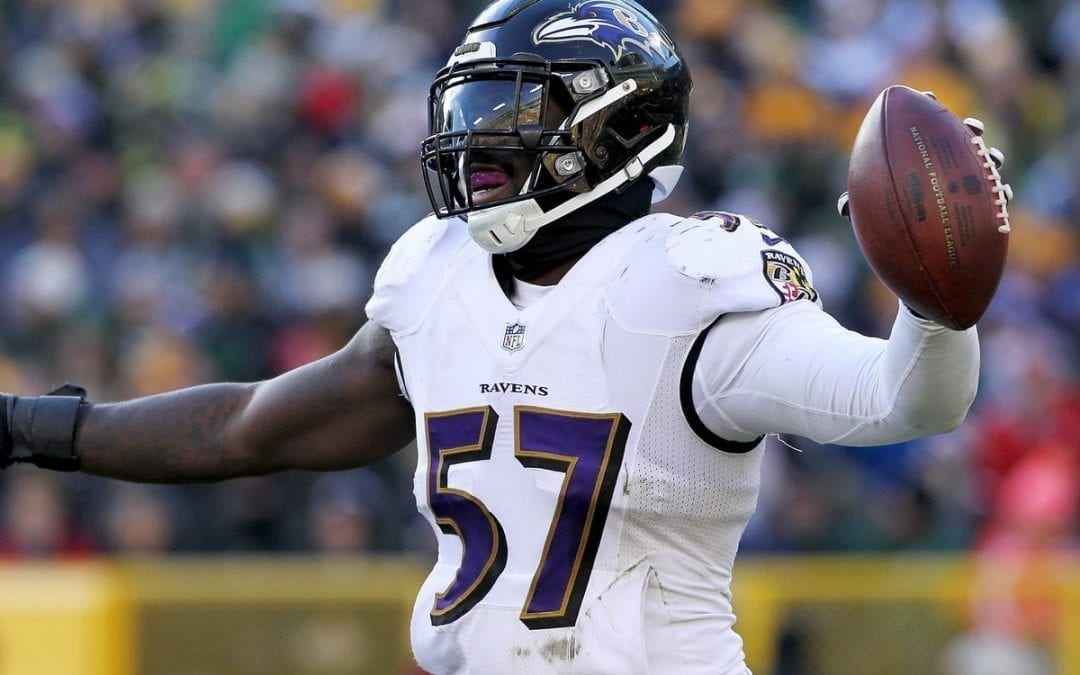
But while the offensive efficiency marks a meaningful and necessary improvement over last season’s dreadful output, defense remains the strength of the Ravens. The unit has allowed just 51 points through three games and has twice held an opponent to 14 points or fewer. Baltimore’s defense has thrived even by the advanced metrics, with Football Outsiders rating it fifth overall by DVOA.
[Discuss this article on the BSL Board here.]
A significant reason for that success, opponents have struggled mightily to pass on the Ravens. The defense’s 67.6 passer rating through three weeks ranks behind only the Miami Dolphins, and Baltimore has only allowed four receiving touchdowns over that span. Those exceptional figures derive in large part from a more democratic pass rush, one in which six different players have already registered a sack. The most noticeable improvement has come from fourth-year outside linebacker Za’Darius Smith, who has registered two sacks and six quarterback hits on just 127 defensive snaps (roughly one pressure every 16 snaps). That has allowed Baltimore to reduce Terrell Suggs’ workload to 117 snaps, though he leads the team with 2.5 sacks and maintains a respectable 19.5 snaps-per-pressure rate.
The back seven of defense has played a role in the Ravens’ defensive success as well. Fourth-round rookie Kenny Young has already become a fixture, seeing more snaps from scrimmage (125) than any of the team’s other off-ball linebackers. Though primarily an overhang defender, Young has a knack for making plays in the backfield. His three tackles for loss tie for the team lead, and his four pressures rank most among non-edge rushers on the roster. That newfound playmaking and speed in the middle have allowed Baltimore to overcome star linebacker C.J. Mosley’s knee injury.
On the back end of the defense, the mostly old but capable secondary of Brandon Carr, Eric Weddle, Tony Jefferson, and Marlon Humprey has held its own. The pressure generated by the defensive front has meant more opportunities for the defensive backs to make plays on the ball, and already they have combined for 11 pass breakups and three interceptions. That figure doesn’t even account for nickelback Tavon Young, who has admirably covered slot receivers while also making plays in the backfield (two sacks, two QB hits, and three tackles for loss). While no one will confuse the group with the league’s elite secondaries, the Ravens have little about which to complain.
All of those components have combined to give the Ravens one of the league’s most reliable defenses, one that can keep the team in playoff contention. The specter of injuries and general fatigue suggest the unit could regress as the year unfolds. At the same time, Baltimore might have some built-in improvement waiting ahead.
Mosley, the Ravens’ best inside linebacker since Ray Lewis’ retirement, essentially hasn’t played for two games. Though his status for the team’s upcoming tilt with the Pittsburgh Steelers remains unclear, Mosley fully participated in Thursday’s practice, the strongest indication to date that he will return to the lineup soon. The presence of Mosley alongside Young gives Baltimore one of the most athletic and dangerous off-ball linebacker tandems in the league.
Though Smith and Suggs have anchored the pass rush, the Ravens have several prospects who could become significant contributors by the end of the season. Second-year outside linebackers Tim Williams and Tyus Bowser have secured meaningful roles in the defense (57 and 41 snaps respectively through three games). Both entered the league with underdeveloped games but attractive athletic profiles. With players so young with such high ceilings, the consistent play should lead to better production at some point.
Meanwhile, the secondary should receive a boost after Week 4 when cornerback Jimmy Smith returns from suspension. Smith has served as the team’s top corner for the majority of his eight-year professional career, though various injuries and multiple suspensions have removed him from the field in recent seasons. Even so, Smith gives the Ravens a genuine No. 1 cover man for the top-flight wideouts on their schedule, a collection that includes Michael Thomas, Julio Jones, A.J. Green, and Antonio Brown. Smith’s return will also strengthen Baltimore’s depth at one of the most important positions in the game.
Of course, while those areas of the Ravens defense could improve, others could falter. The first-time starters could hit the proverbial wall later in the season, better offenses could reveal defensive flaws heretofore unexposed, and injuries can thin out even the unit’s deepest positions. These factors have derailed Baltimore in the past, and nothing rules out one or more coming into play again.
Still, the possibility exists that the Ravens’ already stellar defense hasn’t even hit its stride yet.

Jason B. Hirschhorn is an award-winning sports journalist and Pro Football Writers of America member. He has bylines at NFL.com, SB Nation, Sports Illustrated, and other outlets.