
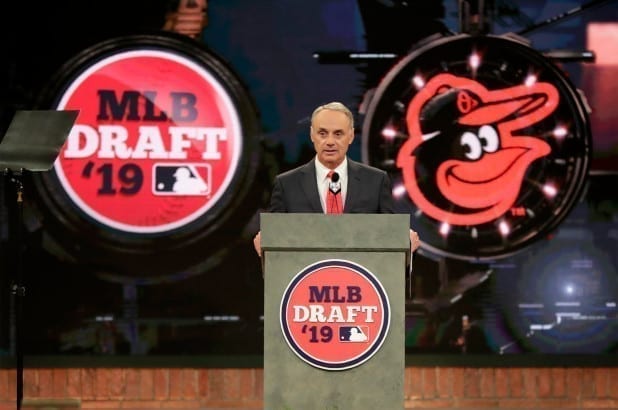
The college baseball season begins in two weeks. The 2020 MLB Draft season began much earlier. Some people will say that this year’s draft season began the moment after the Boston Red Sox called Garrett Irvin’s name as the 1217th and final pick of the 2019 Draft. Others will say that the season began the moment the players under consideration for this year’s draft first picked up a bat or ball, a somewhat poetic approach to the question.
To me, the 2020 Draft began on July 12th, 2017 at 5:01 P.M. I had recently left the Tampa Bay Rays and was driving to Virginia to take my current position as a Professor at Sweet Briar College. More importantly, the deadline for 2017 draftees to sign with teams had just passed. With that deadline, teams suddenly were able to place players on a future timeline. Asa Lacy, drafted in the 31st Round by the Cleveland Indians, decided to attend college at Texas A&M. Austin Martin, also drafted by the Indians, would head to the college baseball powerhouse of Vanderbilt. And Emerson Hancock, a 38th Round pick by the Diamondbacks, would be guaranteed to see Martin several times in conference play by attending the University of Georgia.
None of these three players were worthy of such low draft spots. Each of them ranked in the Top 150 of players—Martin topped the trio as the 134th-best prospect according to Baseball America—available that year, depending on the source. However, the MLB Draft system being what it is, their commitments to their colleges and bonus demands resulted in their being put by the wayside, left until teams picked them as potential Hail Mary’s or insurance in case a higher-ranked draftee signing fell through.
As college players, those three were unable to reenter the draft until after their Junior season (None of them qualified to be age-eligible sophomores as they would reach their 21st birthday after the deadline for the 2018 draft). That time has come, and each of Martin, Lacy, and Hancock will likely find themselves at the top of draft boards come June.
This year’s class differs from 2019 in a key way: there is no consensus #1 pick. While one could—and many did—debate the merits of Bobby Witt Jr. versus Adley Rutschman, by June it was clear that Rutschman topped the class and only signing concerns could derail him from being the #1 pick. This year, there are many routes teams could go, from slugging first basemen to highly-athletic middle infielders to top of the rotation arms.
This is where the Orioles find themselves, picking second in a draft full of possibilities. Only the Tigers are ahead of them to derail any potential plans that Mike Elias and company may have. While there are many twists and turns that are likely to occur, it’s worthwhile to get an introduction to five players that will likely dominate draft discussions over the next five months. These five—Arizona State’s Spencer Torkelson, New Mexico State’s Nick Gonzazlez, and the aforementioned Lacy, Hancock, and Martin—all come with their strengths and weaknesses as players as well as pros and cons about the route they can go. Regardless of the route, the Orioles are likely to get a top tier player to add to their improving farm system on June 10th.
Spencer Torkelson
Baseball America’s top-ranked prospect—as of their latest rankings update on January 8th—offers excellent production from the right side of the plate. In two years at Arizona State, he showed solid bat-to-ball ability evidenced by a .337 average with good discipline (A walk rate of 14.5% with a strikeout rate of 16.3%). His at bats show a nice swing with an ability to take the ball the other way, and he’s even young for a college player to boot—20.8 years old on draft day. But his calling card is his power; 25 homers as a Freshman and 23 as a Sophomore with an ISO of .386—For comparison’s sake, Kris Bryant hit 23 homers and had a.270 ISO over his first two years in a very different environment at UC San Diego. Torkelson’s profile—a right firstbaseman—is one that usually doesn’t lead to being drafted very highly. To add value Torkelson’s bat has to be special to overcome his defensive profile. Fortunately, the bat seems special, and he figures to continue his tear going into June.
Emerson Hancock
Hancock’s Freshman year at Georgia was a little disappointing, walking nearly 4 batters per nine and a 5.10 ERA. For such a highly touted recruit, much more was expected. His sophomore season made up for it, striking out over a batter an inning with a 0.84 WHIP and 1.99 ERA. Hancock has a great pitcher’s body at 6’4″ 215 pounds and throws his pitches out of a 3/4 to low-3/4 arm slot. The stuff is nice, with a good foundational pitch mix that has four potential pluses as his secondary pitches improve. This is the player that Baseball America mocks the Orioles to take, and he would be a great compliment to Adley Rutschman at the top of the organization’s prospect list.
Austin Martin
Martin’s calling card is his hit tool. In two years at Vanderbilt, he’s hit .376 with an impressive .410 during his sophomore year. The plate discipline is there too, as he walks nearly as often as he strikes out. There isn’t a ton of power in the profile currently—.145 ISO and 9 career home runs—but he still has some room to develop there. The biggest question remaining with Martin is if he can handle shortstop effectively. He seemed to have the tools for this in high school, but has been relegated to third base duty in his first two years at Vanderbilt. If he continues his hitting and proves a capable defender, he will be well-worthy of Baseball America’s top overall mock draft pick. For a system that is decidedly lacking in middle infield talent, that would be a major addition for the Orioles.
Asa Lacy
I’ve been a fan of Lacy since his high school Senior year, in part because I like lefties who have a feel for a changeup so early. If Emerson Hancock hadn’t moved forward so much during his Sophomore year, Lacy would likely have topped pitching boards this year. You could still make an argument for it. In two years at Texas A&M Lacy has struck out 178 batters in 128 innings, an incredible 12.5 K/9. His ERA has been sub-3 (2.75 and 2.13) both years, and his WHIP has been 1.07 over the career. His fastball sits around 94, throws two breaking pitches and the aforementioned changeup. Friday April 3rd will likely see Lacy and Hancock face off, probably with the year’s largest contingent of scouts in attendance.
Nick Gonzales
Gonzales shot up draft boards with a strong showing in the Cape Cod League in 2019. The New Mexico State second baseman’s numbers had been strong in his first two years—.392/.484/.690 slash line—but that came in very hitter-friendly conditions in a relatively weak conference. The wood-bat numbers—.351/.451/.630 with 7 homers—against elite competition somewhat quieted doubters. That said, there will surely be questions if his production dips at all this season, to go along with doubters of a college second baseman with less room to extract positional value than, say, Martin.
———
All in all, this draft represents another major opportunity for the Orioles to continue to rebuild the farm system. Given the lack of movement on the international front, the draft represents one of the few avenues for the team to do so. Several options exist, including many college arms who project to be frontline starters. Many changes will happen between now and June, but it will be exciting to see what falls into place for the Orioles at the second pick.

Orioles Analyst
Dr. Stephen Loftus received his Ph.D. in Statistics from Virginia Tech in 2015 and is an Assistant Professor of Mathematical Sciences at Randolph-Macon College. Prior to that, he worked as an Analyst in Baseball Research and Development for the Tampa Bay Rays, focusing on the Amateur Draft. He formerly wrote at FanGraphs and Beyond the Box Score. As a lifelong fan of the Orioles, he fondly remembers the playoff teams of 1996-97 and prefers to forget constantly impending doom of Jorge Julio, Albert Belle’s contract, and most years between 1998 and 2011.